

Because every UAV mission starts on a platform
Multi-platform maritime UAV integration
At sea, every UAV depends on the platform that carries it. Whether deployed from a RHIB, a patrol vessel or an unmanned surface vehicle (USV), a maritime UAV must adapt to onboard constraints, systems and mission requirements.
Maritime UAV integration ensures that aerial systems operate as part of a coherent operational architecture, linking the drone with onboard equipment and command systems. Without this integration, UAV operations remain limited in safety and effectiveness.
Integration is therefore at the core of DIODON’s activity. Through field testing and operational deployments, DIODON has developed proven expertise in UAV integration across naval platforms, including UAV–USV interoperability, as well as C2 and CMS integration.
This experience enables the delivery of reliable integration solutions, allowing operators to deploy UAV capabilities with confidence and immediate operational relevance.
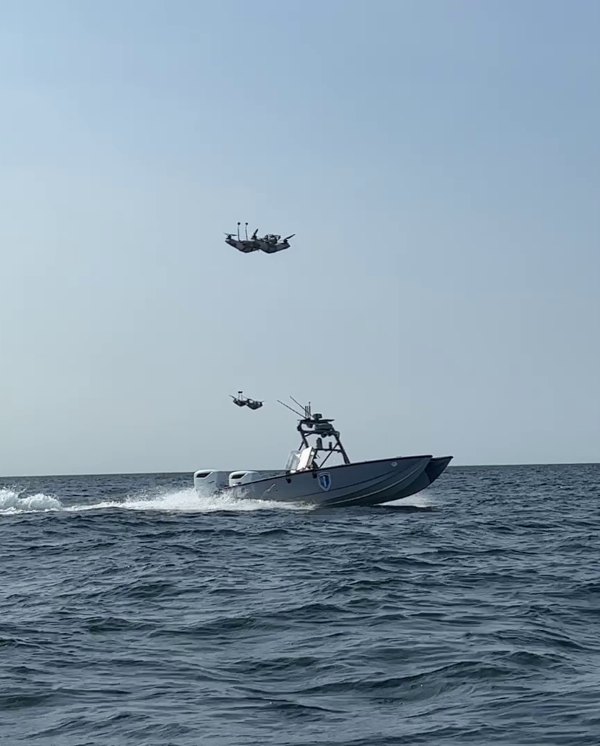
Proven through extensive sea testing and operational exercices
Maritime UAV integration on USV
Interoperability between UAVs and USVs has been a key focus for DIODON, developed through years of work across different uncrewed surface platforms and operational environments.
These efforts have demonstrated the value of combining aerial and surface systems to extend operational range, increase persistence and support distributed maritime operations.
Building on this experience, DIODON developed the DIODON Launcher, enabling stable deployment of the HP30 from USVs. The system has been successfully demonstrated during a major NATO exercise and is already in operational use.
DIODON HP30 integrated across multiple USVs during NATO Task Force X.
Off-board sensor
Extended ISR reach
All-sea proven
Made for harsh environments
Modular mount
Fits multiple USVs
Autonomous operation
Minimal interaction needed
From RHIBs, to fast patrol vessels & larger naval units
Maritime UAV integration on boats
Deploying a UAV from a moving vessel requires dedicated hardware to ensure safe and repeatable operations at sea. Maritime UAV integration includes tailored launch and recovery systems adapted to the size, structure and constraints of each platform, from RHIBs to larger naval units. These solutions enable reliable deployment and recovery in maritime environments and can be complemented by software interfaces connecting the UAV to onboard command systems.
The system can also operate in standalone mode when no onboard integration is available. In this configuration, the UAV is deployed directly from the water and controlled using the GCS, providing a simple and effective solution for small units or rapid operations.
Drawing on experience across multiple vessels and operational contexts, DIODON supports naval units in implementing hardware, software and standalone integration schemes. The objective is to ensure that UAV operations become a natural extension of the platform.
Hardware integration
Automatic launch & recovery
Adaptable to vessel size
Software integration
Compatible with varied C2
Standalone mode
Water launch deployment
GCS-only operation

Embedding uav capabilities into naval system architectures
Maritime UAV integration on C2 & CMS
Integration into command and control systems (C2) and combat management systems (CMS) is a key component of maritime UAV integration. DIODON has carried out multiple integrations across different naval software environments, enabling aerial video and mission data to be directly available within operator systems.
These capabilities are already deployed on several platforms and used in operational conditions, ensuring seamless integration of UAV data into existing workflows.
By consolidating information within a single environment, operators benefit from improved situational awareness while avoiding parallel interfaces, resulting in more efficient mission execution.