
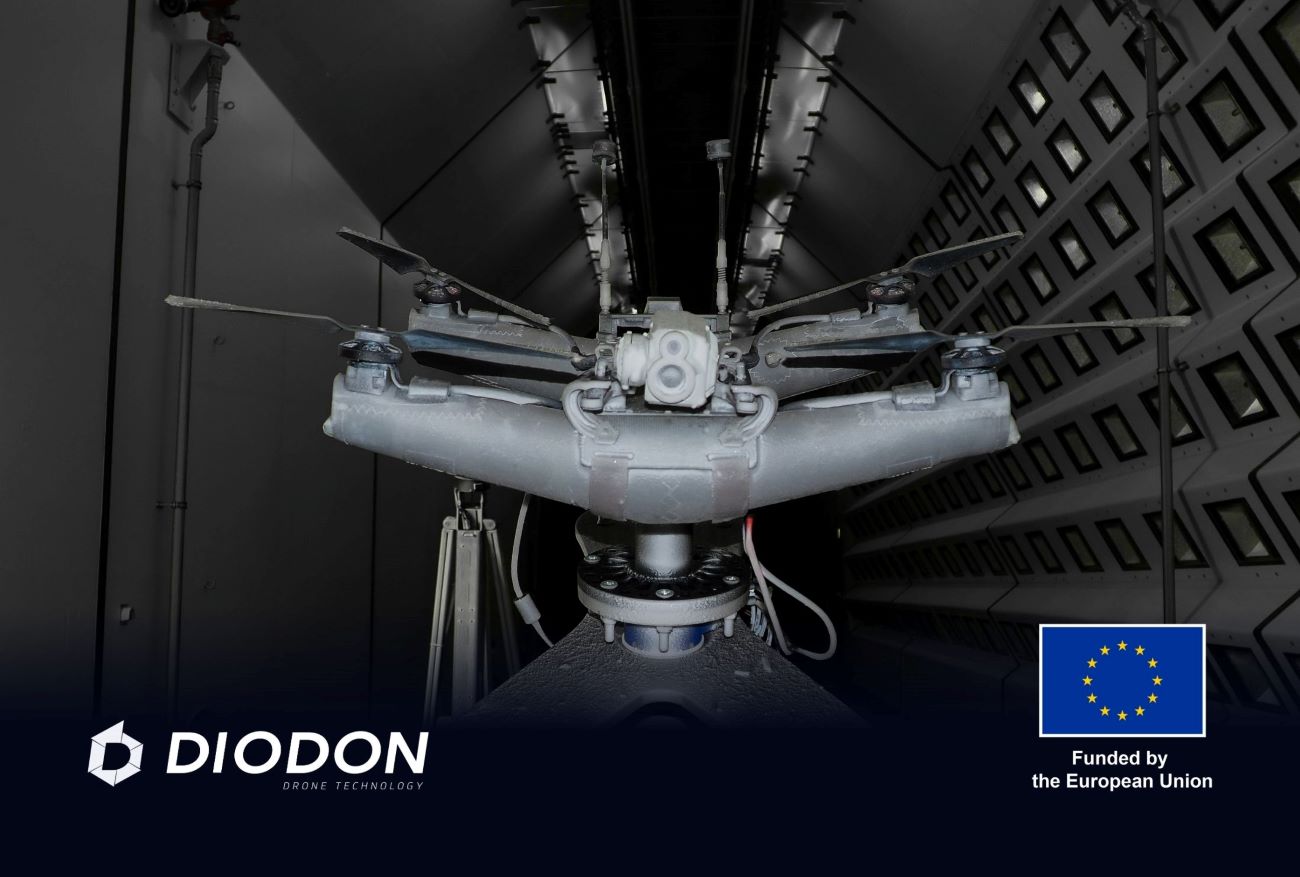
DIODON Drone Technology continues its participation in TDRIC (Tactical Drones in Rain and Icing Conditions), a project funded by the European Defence Fund (EDF) and conducted by a European consortium including Pegasus Research & Development, CEiiA, CYRIC, RTA and UBIQ Aerospace AS.
The project aims to improve UAV performance and operational resilience in extreme weather environments, particularly under heavy rain and icing conditions.
Combined rain and icing testing in controlled conditions
As part of this campaign, the DIODON HP30 was tested inside the world’s largest icing wind tunnel in Vienna. The trials combined heavy rain, strong wind and temperatures down to -15°C, reproducing realistic extreme-weather scenarios.
DIODON systems were originally designed to operate in demanding maritime environments, where exposure to rain, humidity, salt and wind is constant. These tests therefore confirmed stable performance under intense rainfall while allowing detailed observation of system behaviour in freezing and icing conditions.
The campaign provided valuable data on propulsion behaviour, power distribution and flight stability under frost accumulation, refining understanding of endurance and energy management in extreme cold environments.
Continuing to strengthen all-weather UAV capabilities
This testing phase represents one milestone within the broader TDRIC programme, which continues under the European Defence Fund framework.
The objective remains consistent: ensure that tactical UAV systems can maintain operational capability in heavy rain, freezing temperatures conditions and icing environments, where sustained aerial presence is often mission-critical.

“The TDRIC project came as a natural continuation of our work on reliable, all-weather UAV systems. It allowed us to validate our design choices with real data and to strengthen our expertise in developing drones that truly perform in harsh climates.”
— Theo NGUYEN, Head of Engineering | DIODON Drone Technology.
Through this European collaboration, DIODON continues to strengthen the robustness of its maritime UAV systems in rain and cold-weather environments.
« Funded by the European Union. Views and opinions expressed are however those of the author(s) only and do not necessarily reflect those of the European Union or DEFIS. Neither the European Union nor the granting authority can be held responsible for them. »